


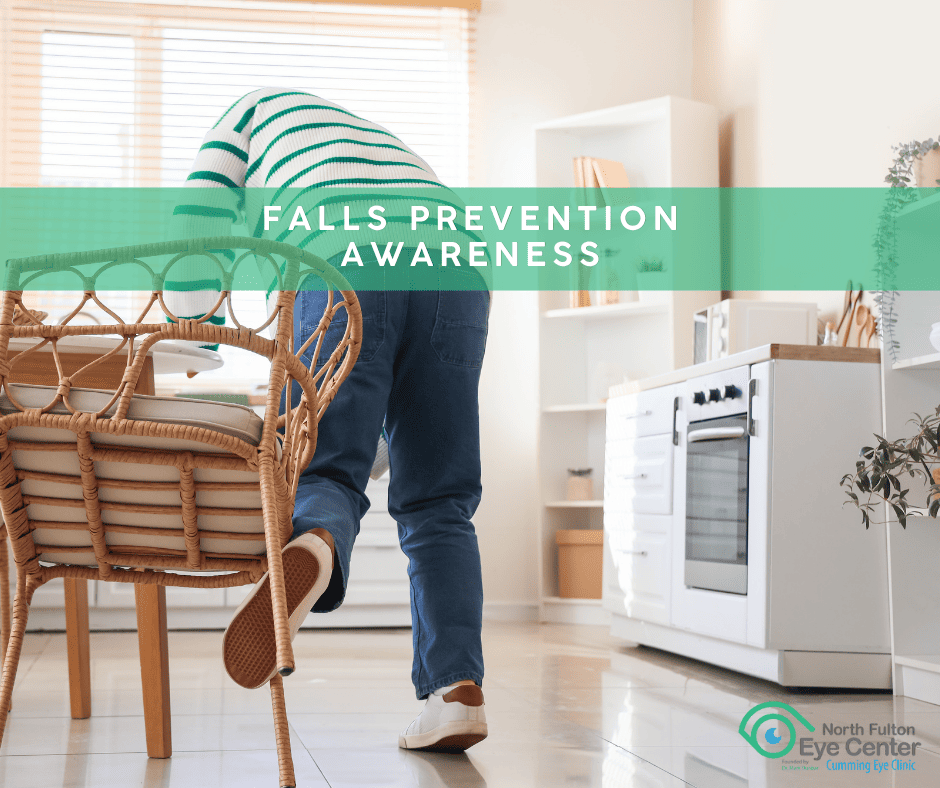
A fall is rarely caused by one factor alone. Strength, balance, medications, blood pressure, home hazards, footwear and chronic medical conditions can all contribute. Vision is another important part of that picture.
According to the National Institute on Aging, more than one in four adults age 65 and older falls each year. Falls can lead to fractures, hospitalization, loss of confidence and reduced independence. Many falls, however, can be prevented.
Falls Prevention Awareness is an appropriate time for older adults and their families to consider whether a change in vision may be making it more difficult to move safely through familiar surroundings.
Vision helps the brain understand the environment
Safe movement depends on the eyes and brain working together with the inner ear, muscles, joints and nervous system.
Vision provides information about:
- The location of steps, curbs and obstacles
- Changes in flooring or elevation
- The distance between objects
- Movement in peripheral areas
- Differences between light and dark surfaces
- Body position in relation to the surroundings
When visual acuity, peripheral vision, depth perception or contrast sensitivity declines, a person may have more difficulty detecting hazards or judging distances. The risk can become greater in dim lighting, on uneven ground or when moving between environments with very different light levels.
A person may still be able to read letters on an eye chart while experiencing other visual limitations that affect mobility. This is one reason a comprehensive eye examination evaluates more than sharpness of vision alone.
Cataracts can make steps and obstacles harder to see
Cataracts may cause blurred vision, glare, reduced contrast sensitivity and difficulty seeing in low light. These changes can make nighttime navigation and unfamiliar environments more challenging.
Someone with cataracts may have trouble distinguishing a pale step from a similarly colored floor or recovering visually after looking toward bright headlights. Depth judgment may also become less reliable when one eye is more affected than the other.
A brighter room may help, but lighting should be even and positioned to reduce glare. Dramatic changes between brightly lit and dark areas can be difficult for aging eyes to manage.
When cataracts interfere with safe mobility, driving or everyday activities, an ophthalmologist can discuss whether cataract surgery is appropriate. The decision should reflect the patient’s functional needs, eye health and overall medical condition.
Glaucoma may affect peripheral awareness
Glaucoma can gradually damage peripheral vision. Because the earliest changes may be subtle, a person might not recognize the loss immediately.
Reduced peripheral vision can make it harder to detect an obstacle approaching from the side, notice the edge of a step or navigate a crowded environment. More advanced visual-field loss can significantly affect orientation and mobility.
Glaucoma treatment cannot restore vision already lost, but lowering eye pressure can reduce the likelihood of further damage. Patients using glaucoma medication should take it as prescribed and attend scheduled follow-up visits so their ophthalmologist can monitor eye pressure, optic-nerve health and visual fields.
Macular degeneration can affect detail and contrast
Age-related macular degeneration primarily affects central vision. A person may have difficulty seeing fine detail, recognizing faces or identifying objects directly ahead.
AMD can also affect contrast sensitivity, making similarly colored objects more difficult to distinguish. A dark object against a dark floor or a light-colored curb in bright sunlight may be less visible.
Peripheral vision often remains available, but patients may need time and guidance to learn how to use it effectively. Low-vision rehabilitation can help some people use remaining vision more efficiently and identify tools or environmental changes that support independence.
Diabetic eye disease may cause fluctuating or progressive changes
Diabetes can affect vision in several ways. Changes in blood glucose may temporarily alter focus, while diabetic retinopathy and diabetic macular edema can cause more persistent vision loss.
Blurred or fluctuating vision can affect depth judgment and confidence while walking. More advanced retinal disease may create missing or distorted areas in the visual field.
People with diabetes should receive dilated eye examinations on the schedule recommended by their healthcare team. Managing blood glucose, blood pressure and cholesterol also remains an important part of reducing the risk of diabetic eye complications.
Sudden vision changes should not be assumed to result from a temporary change in blood sugar. They require appropriate medical evaluation.
A new prescription may require an adjustment period
An outdated glasses prescription can contribute to blurred vision, but a new prescription can temporarily change how distances, steps or floor surfaces appear.
Progressive and bifocal lenses provide different focusing zones within the same lens. When a person looks downward through the reading portion, the floor may appear blurred or displaced. This can be especially noticeable on stairs.
Patients should learn how to position their head and eyes appropriately while using multifocal lenses. Some older adults may benefit from separate glasses for certain activities, but recommendations should be individualized.
Any persistent dizziness, distortion or difficulty navigating in new glasses should be discussed with the prescribing eye-care professional. Glasses should also fit securely; frames that slide down the nose can change where the patient looks through the lenses.
Improving the home’s visual environment
Simple environmental changes can make hazards easier to see:
- Provide even lighting in hallways, stairways and bathrooms.
- Use night-lights between the bedroom and bathroom.
- Place light switches near room entrances.
- Reduce glare from uncovered bulbs and highly reflective surfaces.
- Mark the edges of steps with contrasting material when appropriate.
- Keep frequently used walking routes free of cords and clutter.
- Secure loose rugs or remove them.
- Use contrasting colors to make grab bars, furniture edges or bathroom fixtures easier to identify.
- Keep glasses clean and within reach.
- Wear prescribed distance glasses when walking if they are needed for safe navigation.
These changes address only part of fall prevention. Strength and balance exercises, medication reviews, appropriate footwear, hearing care and evaluation of dizziness or blood-pressure changes may also be necessary.
An eye examination is one part of a complete fall-risk evaluation
A comprehensive eye examination can identify correctable refractive errors and evaluate for cataracts, glaucoma, macular degeneration, diabetic eye disease and other conditions that may affect safe mobility.
Patients should tell their ophthalmologist if they have recently fallen, begun avoiding stairs, stopped driving at night or become less confident in unfamiliar places. These functional changes can provide important information even when the patient does not describe the problem as vision loss.
An ophthalmologist may recommend updated glasses, medical treatment, surgery, additional testing or referral for low-vision services. If vision does not fully explain the problem, the patient may also need evaluation by a primary care physician, neurologist, physical therapist, audiologist or another specialist.
When a fall includes an eye or head injury
A person who strikes the eye, face or head during a fall should be monitored carefully. Emergency evaluation is appropriate for loss of consciousness, confusion, weakness, severe headache, vomiting or other possible signs of head injury.
Urgent eye symptoms following a fall include:
- Sudden vision loss or marked blurring
- New double vision
- Flashes, floaters or a curtain-like shadow
- Severe eye pain
- Blood inside the eye
- An irregularly shaped pupil
- Difficulty moving one or both eyes
- Significant swelling accompanied by reduced vision
A normal-looking eye can still have an internal injury. Patients should not press on the eye or attempt to treat a suspected serious injury at home.
Clearer vision can support safer, more confident movement
Fall prevention is not about restricting activity. In fact, avoiding movement because of fear can contribute to weakness and further instability. The goal is to identify modifiable risks so older adults can remain active as safely as possible.
Vision is only one part of that effort, but it is an important and sometimes overlooked one. Detecting eye disease, updating a prescription, improving contrast and lighting, or connecting a patient with low-vision rehabilitation may help preserve both safety and independence.
For patients seeking senior eye care in Roswell or a comprehensive eye examination near Cumming, North Fulton Eye Center evaluates how vision affects everyday function—not simply how many letters a person can read on a chart.
North Fulton Eye Center is a trusted leader in North Fulton eye care for a reason: its ophthalmology team understands that protecting vision also means protecting mobility, confidence and independence. Through careful examinations, medical and surgical eye care, and individualized recommendations, the practice helps patients and families address visual risks as part of a more complete approach to healthy aging and fall prevention.