


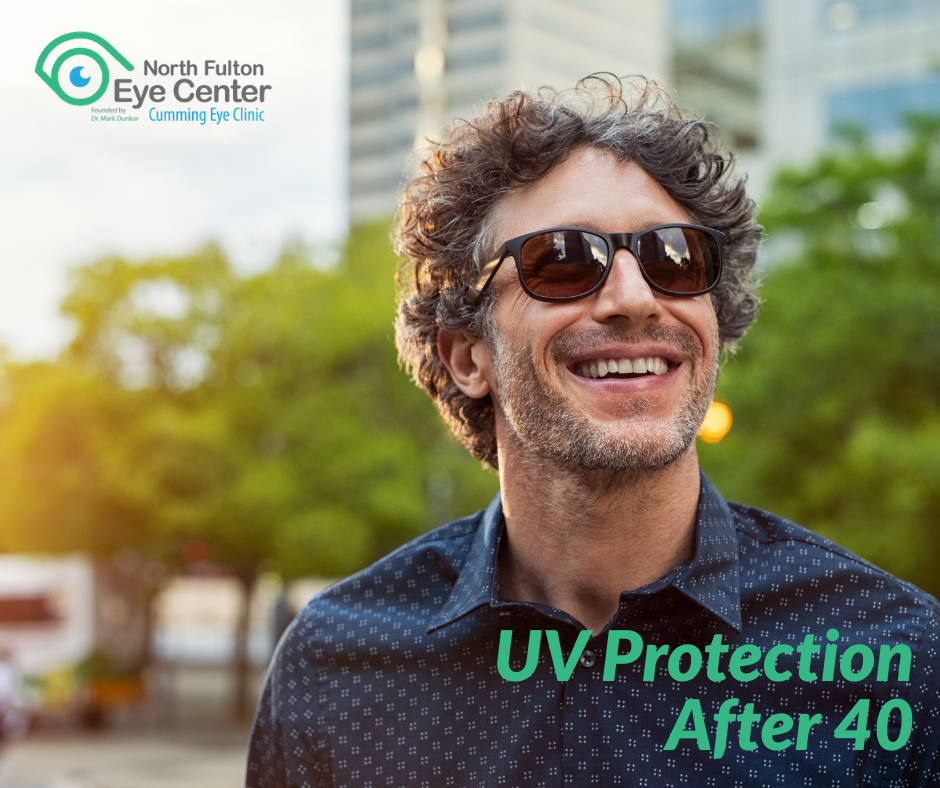
July is recognized as UV Safety Month, a national reminder to protect your skin and eyes from the long-term effects of ultraviolet radiation. While many people remember sunscreen, hats, and shade, eye protection is often treated as optional – something we reach for on vacation, at the pool, or while driving into bright sunlight. But for adults, especially those over 40, UV protection should be part of everyday eye care.
At North Fulton Eye Center and Cumming Eye Clinic, we often remind patients that sun protection is not just about comfort. It is also about protecting the delicate structures of the eye from cumulative damage over time.
UV exposure is not just a skin concern
Ultraviolet light is invisible, but it can still affect the eyes. The National Eye Institute notes that UV light can penetrate eye tissues more easily than visible light, potentially increasing the risk of certain eye problems. Long-term UV exposure has been associated with cataracts, growths on the surface of the eye such as pinguecula and pterygium, eyelid cancers, and possibly age-related macular degeneration.
Unlike a sunburn on the skin, UV-related eye changes may not be immediately noticeable. Many conditions develop slowly, which is why patients may not connect years of unprotected sun exposure with changes in their vision later in life.
Why UV protection becomes even more important with age
As we get older, our eyes naturally become more vulnerable to certain conditions, including cataracts, dry eye, glare sensitivity, and retinal changes. Cataracts, in particular, are extremely common with age. The National Eye Institute recommends protecting the eyes from the sun with sunglasses and a brimmed hat, and notes that cataract surgery involves removing the clouded natural lens and replacing it with an artificial lens called an intraocular lens, or IOL.
Even before cataract surgery is needed, many adults begin to notice more glare while driving, more difficulty in bright sunlight, or more discomfort outdoors. UV-blocking sunglasses can help reduce glare and support long-term eye protection, especially when used consistently.
After cataract surgery, sunglasses still matter
Cataract surgery can dramatically improve clarity of vision for many patients, but it does not mean patients should stop protecting their eyes from the sun. In fact, many patients notice that the world looks brighter after surgery because the cloudy natural lens has been replaced with a clear artificial lens.
Your ophthalmologist will give you specific instructions after surgery, and those instructions should always come first. In general, however, wearing protective sunglasses outdoors after cataract surgery helps reduce light sensitivity, improve comfort, and protect the eyes from UV exposure, wind, dust, pollen, and outdoor debris during the healing period.
Long term, sunglasses remain important because UV exposure can still affect the eyelids, ocular surface, and surrounding skin. If you had cataract surgery many years ago and are unsure what type of lens implant you received, it is worth asking your ophthalmologist whether any additional UV protection considerations apply to you.
Not all sunglasses protect your eyes equally
One of the biggest misconceptions about sunglasses is that darker lenses automatically offer better protection. They do not. Lens darkness affects comfort, but UV protection comes from the lens material and coating.
When choosing sunglasses, look for labels that say 100% UVA and UVB protection, 99% to 100% UV protection, or UV400. The National Eye Institute advises patients to choose sunglasses that fit well, block light from entering around the lenses, and provide 99% to 100% protection from UVA and UVB rays or a UV400 rating.
Polarized lenses can be helpful, especially for driving, boating, fishing, and spending time near water because they reduce glare. However, polarization alone does not guarantee UV protection. Always check the UV rating.
Daily UV exposure adds up in North Fulton and Forsyth County
Many patients think about UV protection when they are at the beach, but everyday exposure matters too. In our area, patients are often outdoors for youth sports, golf, gardening, walking, tennis, pickleball, boating on Lake Lanier, or simply driving around Roswell, Alpharetta, Cumming, and surrounding communities.
UV exposure can also be higher around reflective surfaces, including water, pavement, sand, and concrete. The National Eye Institute also notes that the UV index can be high even on cloudy days, and that the sun is typically strongest between 10 a.m. and 4 p.m.
For many adults, the most realistic approach is not avoiding the outdoors. It is building better habits: keeping sunglasses in the car, wearing a brimmed hat for longer outdoor activities, choosing prescription sunglasses when needed, and making UV protection part of the same daily routine as sunscreen.
Who should be especially mindful of UV protection?
Everyone benefits from protecting their eyes outdoors, but some patients should be especially consistent. This includes adults with cataracts, patients who have had cataract surgery, people with a history of pterygium or pinguecula, patients with light-colored eyes or significant light sensitivity, outdoor athletes, golfers, boaters, gardeners, and anyone who spends long hours driving or working outside.
Patients with dry eye may also notice that bright sun, wind, heat, and pollen make their eyes feel more irritated. In those cases, sunglasses can provide both UV protection and a physical barrier from environmental triggers.
Prescription sunglasses can make protection easier
For patients who wear glasses, prescription sunglasses can make UV protection much more practical. North Fulton Eye Center Optical offers eyeglasses, designer frames, sunglasses, prescription sunglasses, sport sunglasses, specialty eyewear, and lens treatments that can help reduce glare and ultraviolet exposure. Current patients and new clients may visit the optical with a current prescription, with no appointment necessary.
The right pair should fit comfortably, provide full coverage, and match your lifestyle. A patient who spends time driving may need a different lens solution than someone who plays outdoor sports or spends weekends on the water.
When to schedule an eye exam
UV Safety Month is a good reminder to schedule a comprehensive eye exam, especially if you are noticing new glare, halos, light sensitivity, blurry vision, irritation, or changes in night driving. Many UV-related and age-related eye conditions develop gradually, and early evaluation allows your ophthalmologist to monitor changes and recommend the right treatment or prevention plan.
At North Fulton Eye Center and Cumming Eye Clinic, our ophthalmologists provide personalized care for cataracts, dry eye, glaucoma, macular degeneration, diabetic eye disease, corneal conditions, and comprehensive eye health. Our goal is to help patients protect and preserve their vision at every stage of life.
This July, make UV protection part of your daily eye care routine. Your sunglasses are more than a summer accessory – they are an important tool for long-term vision health.
To schedule an appointment with North Fulton Eye Center or Cumming Eye Clinic, call (770) 475-0123.