

July 23 is World Sjögren’s Day, an awareness day created by the Sjögren’s Foundation to honor Dr. Henrik Sjögren, the Swedish ophthalmologist who first described the disease that now bears his name. The day is an opportunity to raise awareness, improve recognition, and support patients living with Sjögren’s.
For an eye care practice, this awareness day is especially meaningful. Sjögren’s is often associated with dry mouth and joint pain, but for many patients, the eyes are one of the first places symptoms appear.
Sjögren’s can affect the entire body
Sjögren’s is a chronic autoimmune disease that can affect the body’s moisture-producing glands. The two symptoms most commonly associated with Sjögren’s are dry eyes and dry mouth, but the condition can also be connected to fatigue, chronic pain, neuropathy, organ involvement, and other systemic complications.
Because symptoms can develop gradually, many patients spend years assuming their dry eyes are simply from age, allergies, screen time, contact lenses, menopause, medications, or the Atlanta climate. While all of those factors can contribute to dry eye, persistent or severe symptoms deserve a closer look.
Dry eye is not always the same for every patient
Dry eye disease can happen for several reasons. According to the National Eye Institute, dry eye may occur when the eyes do not make enough tears, when tears dry up too quickly, or when the tears do not work properly to keep the surface of the eye comfortable and protected.
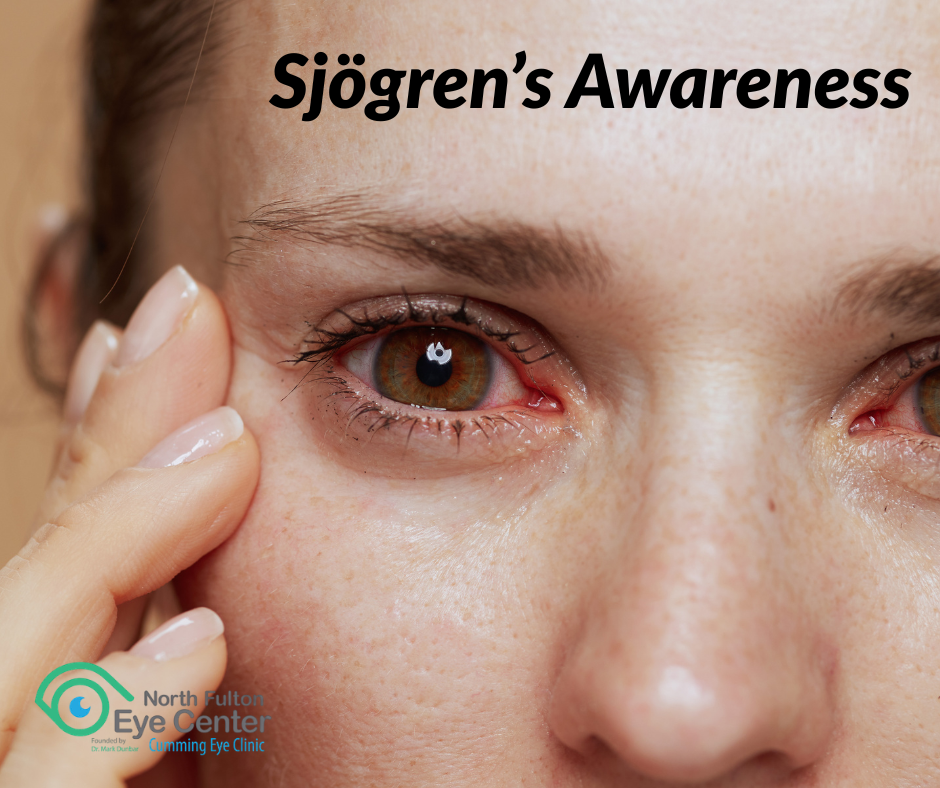
In Sjögren’s, dry eye is often related to reduced tear production. The immune system can attack the glands that produce tears, leading to dryness, burning, stinging, blurred vision, light sensitivity, and a gritty or sandy feeling in the eyes. The American Academy of Ophthalmology lists very dry eyes, blurry vision, burning or stinging, a gritty sensation, and light sensitivity among the eye symptoms that may occur with Sjögren’s.
Some patients also have problems with the oil-producing glands in the eyelids, called meibomian glands. These glands help keep tears from evaporating too quickly. Recent research has shown that meibomian gland dysfunction can also contribute to dry eye in patients with Sjögren’s, which is one reason a detailed eye exam is so important.
When dry eye should be evaluated by an ophthalmologist
Occasional dryness can happen to anyone. But dry eye that is frequent, worsening, painful, or interfering with daily life should be evaluated.
Patients should consider scheduling an eye exam if they experience:
Dryness that does not improve with over-the-counter drops
Burning, stinging, or gritty eyes
Blurred or fluctuating vision
Light sensitivity
Redness or irritation
Difficulty wearing contact lenses
Eye fatigue while reading or using screens
A dry mouth along with dry eyes
A history of autoimmune disease, rheumatoid arthritis, lupus, or unexplained joint pain or fatigue
These symptoms do not automatically mean a patient has Sjögren’s. However, they can be signs that the ocular surface needs medical attention.
Why over-the-counter drops may not be enough
Artificial tears can be helpful for mild dry eye, but Sjögren’s-related dry eye may require a more comprehensive treatment plan. Depending on the patient’s exam findings, treatment may include preservative-free lubricating drops, anti-inflammatory eye drops, eyelid hygiene, warm compresses, tear-conserving strategies such as punctal plugs, or coordination with a rheumatologist or primary care physician.
A review of Sjögren’s-associated dry eye treatment notes that commonly recommended approaches include topical lubricants, topical anti-inflammatory therapy, and tear-conserving strategies.
The right plan depends on the severity of the dryness, the health of the cornea, tear production, eyelid gland function, medications, and the patient’s overall health history. This is why a medical eye exam can be so valuable for patients who feel like they have “tried everything” but still have symptoms.
Dry eye can affect vision, not just comfort
Many people think of dry eye as a nuisance, but the tear film plays an important role in clear vision. When the tear film is unstable, vision may blur or fluctuate throughout the day. Patients may notice that their vision seems worse while reading, driving, using a computer, or spending time in air conditioning.
Untreated or severe dry eye can also affect the surface of the eye. In more advanced cases, inflammation and dryness may contribute to damage of the cornea, the clear front surface of the eye.
This is especially important for patients considering cataract surgery, LASIK, PRK, or other eye procedures. A healthy ocular surface helps with accurate measurements, healing, and overall visual outcomes.
Sjögren’s awareness matters because diagnosis is often delayed
One of the challenges with Sjögren’s is that symptoms can overlap with many other conditions. A patient may see one doctor for dry mouth, another for fatigue, another for joint pain, and an eye doctor for chronic dryness before the pieces are connected.
World Sjögren’s Day is a reminder that dry eye is sometimes part of a bigger health picture. Patients do not need to self-diagnose, but they should feel comfortable bringing up related symptoms during their eye exam. Details such as dry mouth, autoimmune history, medication use, fatigue, joint pain, and previous diagnoses can help guide the evaluation.
How North Fulton Eye Center can help
At North Fulton Eye Center and Cumming Eye Clinic, our ophthalmologists provide comprehensive eye care for patients experiencing dry eye symptoms, ocular surface irritation, vision changes, and inflammatory eye concerns.
For patients with known Sjögren’s, suspected autoimmune-related dry eye, or chronic symptoms that are not improving, an eye exam can help determine how dry eye is affecting the surface of the eye and what treatment options may be appropriate.
World Sjögren’s Day is a meaningful time to remind patients that dry eyes should not be ignored, especially when symptoms are persistent or severe. If your eyes burn, sting, feel gritty, or stay dry despite using drops, it may be time for a medical dry eye evaluation.
To schedule an appointment with North Fulton Eye Center or Cumming Eye Clinic, call (770) 475-0123.